Monday, 1 June 2015

Flow-stick transition in granular materials

The flow-stick transition has been placed at about 50um for dry mineral particles (Smalley 1964, Jones & Pilpel 1966a,b). Particle systems with particles less than 50um are cohesive; with larger particles flow through an orifice is possible. As particle size increases the flow rate increases, gravitational forces overcome cohesive forces. If flow is observed using a 3mm orifice there is a transition point at about 150um.

Bingham, E.C., Wikoff, R.W.  1931.  The flow of dry sand through capillary tubes. Journal of Rheology  2, 395-400.

Jones, T.M., Pilpel, N.  1966a.  The flow properties of granular magnesia.  Journal of Pharmacy & Pharmacology 18, 81-93.

Jones, T.M., Pilpel, N.  1966b.  The flow of granular magnesia.  Journal of Pharmacy & Pharmacology  18, 429-442.

Smalley, I.J.  1964.  Flow-stick transition in powders.  Nature 201, 173-174.


The simple picture is the graph from Smalley (1964); this is crushed quartz passing through a 3mm orifice. A beautifully clear picture of the flow-stick transition ( and probably the first one). At point S flow stops because the gravity forces producing flow are counter-balanced by the cohesive forces in the system. This is at about 50um- an interesting size for all loess people. At point B the orifice is blocked- the particles are simply too large to pass through, simple jamming. Point T is interesting; here is where cohesive forces really begin to be felt; to the left of M cohesive forces are dominant; to the right of M gravity forces are dominant.
Sorry about the sideways nature of this picture. This is from Jones & Pilpel(1966a). Magnesia instead of quartz; a beautiful set of curves; note point S- nicely placed at about 50um, the various aperture sizes are indicated. An interesting observation from the complex picture is that the 3mm aperture was causing a definite 'container' effect. T point is at about 250um, this is clearly observed from the values of flow through the larger apertures. In a general system cohesion effects kick in at sizes below about 250um.
We cite Bingham & Wikoff (1931) because they were possibly the first people to study the flow of granular materials through orifices(?) and because their simple experimental set-up was followed by Smalley (1964) and Jones & Pilpel (1966a). They were more concerned with flow properties- rather than material properties- and did not observe any interesting interactions between gravitational and cohesive forces.

Some loessic relevance?  When loess material is falling from the sky to make a loess deposit the size of the particles is important. Say loess has a mode size around 30-50um, just on the cohesive side of that important reference point. The system is cohesive and this causes an open structure to form, limited compaction on deposition- some obviously but not enough to form a compact sediment. Had the particles been somewhat larger a much simpler packing would have been produced. 100um particles can move relative to each other. 50um particles form open structured systems with quite high tensile strengths, and the strength grows as some cementation occurs. Enough tensile strength to form high vertical faces in exposures, and to retain the open structure until loaded and wetted.

Friday, 6 February 2015

L.S.Berg (1876-1950)

L.S.Berg browsing in the Tin Drum Bookstore in Leicester [no - that's just wishful thinking]. L.S.Berg browsing in the stacks of the Library of the Zoological Institute in Leningrad [maybe].

L.S.Berg was born in 1876 so 2016 is the 140th anniversary of his birth- in Bendery(which is now in Transnistria or perhaps Moldova). His theory of loess formation was published in 1916 ; we have a convenient centenary: 100 years of Loessification.


Thursday, 27 November 2014

Loess & Bee-eaters VII: Poland; South-East Poland; near Przemysl; near Sandomierz

Sepiol, B., Dudzik, K.,  Mandziak, M.  2012.  Breeding population of the European bee-eater Merops apiaster in the Sandomierz Upland 2001-2012. Naturalia 1, 71-86 (in Polish, English summary)
"all the nests were located in loess banks."


Monday, 24 November 2014

Loess & Bee-eaters VI: the European Bee-eater (Merops apiaster) in Hungary... + the Loess in Hungary

Gyuracz, J., Nagy, K., Fuisz, T.I., Kareza, Zs., Szep, T.  2013.  European Bee-eater (Merops apiaster Linnaeus 1758) in Hungary: a review.  Ornis Hungarica 21, 1-22

Kerenyi, Z., Ivok, E.  2013.  Nestsite characteristics of the European Bee-eater (Merops apiaster L) in the Godollo Hills.  Ornis Hungarica 21, 23-32.

Urban, S., Turi, K., Vas, Z., Fuisz, T.I.,  2013.  A successful habitat reconstruction effort, the short history of the European Bee-eater (merops apiaster) colony at Albertirsa (Hungary).  Ornis Hungarica 21, 47-51.


Two maps: Fig.2 shows the distribution of bee-eaters in Hungary- from Gyuracz et al 2013 (the reference listed above); Loess Ground added the colour; its a beautiful and detailed map. The paper shows that there is more of Hungary to be studied from the bee-eater nesting point of view; fig.2 shows bee-eaters in the regions that have been studied.
Fig.4 is a rather less detailed and stylish map- its an old map, from Smalley & Leach 1978, and it hints at loess distribution in Hungary. S & L did not have access to a proper detailed loess map of Hungary; the regions D3 and D4 belong to the outline (emphasize outline) distribution of loess in the Danube Basin and related parts of East-Central Europe. In retrospect its a rather absurd description of the distribution of loess- but actually its not that bad.


Abb.8 is the slightly enhanced map of loess in Hungary from Scheidig 1934. The loess shown by Scheidig and the bee-eater zones of Gyuracz et al do show a good correlation. Hungary must be close to some sort of northern limit for bee-eater nesting; the reports of bee-eaters in Poland and the Czech Republic are not reports of large well established populations; in Hungary there are substantial numbers.

"The 27 colourful & morphologically uniform species of the Meropidae family are divided into 3 genera. The 3 species belonging to the Nyctiornis (2 species) and Meropogon (1 specie) genera are confined to the Far East, from the Himalayan Mountains to the Sulawesi; while the 24 species of the Merops genus can be divided into 2 biogeographical and ecological species clade on the basis of phylogenetic analysis.." (Gyuracz et al 2013)


The Meropidae

Tuesday, 18 November 2014

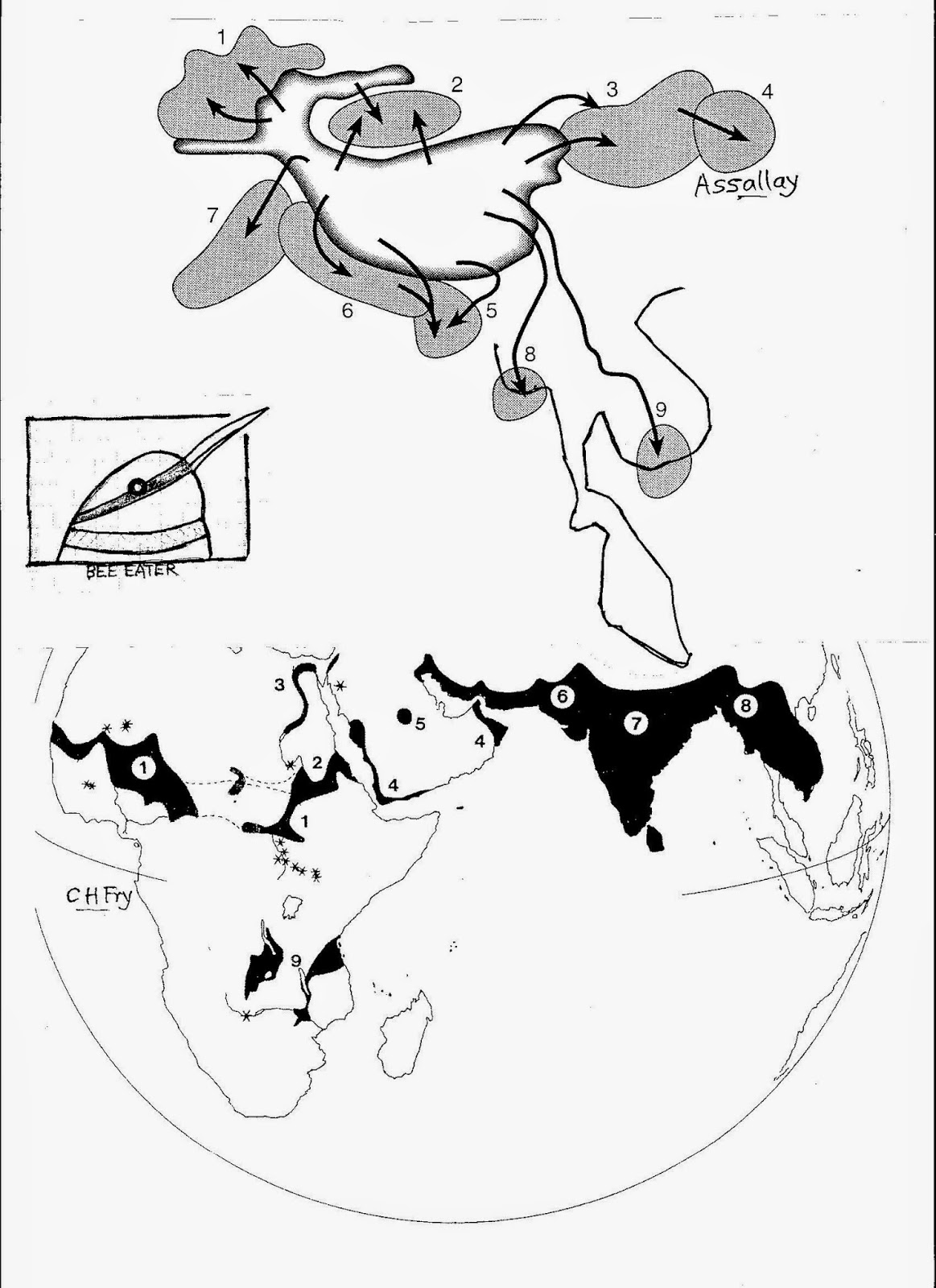
Loess & Bee-eaters V: Long rivers, silty banks, material from High Asia: a South-East Asian perspective.

The Loess & Bee-eaters project is developing. Bee-eater birds (family Meropidae) like to nest in loess tunnels- a study of this aspect of their behaviour should throw some light on the nature of loess ground and on the behaviour of the birds. Soil Mechanics meets Ornithology- under the blanket of Quaternary Studies and Geography. Four parts so far: part one deals with the European Bee-eater (Merops apiaster) and is largely focussed on soil properties and the implications of the Heneberg Compromise: part two deals with the 15N band of Africa and the Northern Carmine Bee-eater (Merops nubicus): part three is set on the Indian sub-continent, and part four is in Australia. The science possibly becomes a bit dilute as the sequence progresses and the stories become more speculative and discursive. Now, for a moment, we look at bee-eaters in south-east Asia. We start with the Alekseev-Dodonov map, with some critical rivers emphasised:
The red rivers carry silt away from High Asia to form bank deposits and delta deposits. Some rivers carry silt away from High Asia to form loess deposits. River transportation and loess deposit formation are related. A question: is the river silt available to bee-eaters in the same way that loess silt is available, and sought after?  How does the delivery of large amounts of silt into S.E.Asia influence the nesting of the bee-eaters?  This map, Loess Letter Map 2, is the famous map by Alekseev & Dodonov 1989- its main purpose was to show the position of the loess in China, but it serves the wider purpose of showing High Asia and associated rivers.

Pictures from Assallay et al (1998) and C.H.Fry (1984). The Assallay picture shows High Asia (it was based on the Alekseev-Dodonov map above)- the rivers indicated carry silt away from High Asia; the ones of immediate concern are rivers 8 and 9: the Irrawaddy and the Mekong. The local conditions inhibit loess deposit formation; the silt goes into bank deposits and delta deposits. So, abundant silt in S.E.Asia.
The Fry picture shows bee-eater nesting across Africa and Asia; not all bee-eaters- these are the data for the Little Green Bee-eater (Merops orientalis); 8 is Merops orientalis ferrugeiceps. Question: does the presence of High-Asia silt facilitate the nesting of the Little Gree Bee-eater in S.E.Asia?
The Little Green Bee-eater is perhaps not the best species to focus on in a study of the relationship of birds to ground. This is the smallest of the Bee-eaters (about the size of a sparrow) and it may be that its small size allows it to nest in grounds which are inaccessible to larger birds- as the Fry figure shows, it does have a wide distribution. No question of this bird being restricted to loess.

Friday, 26 September 2014

Glacial Loess: revisited, reviewed, reconsidered

Matti Seppala (2004, p.213) wrote that " Smalley (1966) proposed that glacial grinding provided loess material and the idea was supported by Boulton (1978, p.796)." Another sentence from Seppala (2004, P.117) "Butzer (1965) defined loess according to its origin as two types (1) periglacial loess, deflated from outwash deposits, from freshly exposed till, and from barren rock and tundra surfaces, and (2) desert or continental loess originated from desert areas."
What Butzer was saying was that loess material for loess deposits came from periglacial regions and desert regions. This is actually quite a reasonable statement provided that one realises that the loess material may have been introduced into the periglacial or desert areas- the actual source of the particles, the place where the particles were made, may be elsewhere. There have been long years of confusion when it was thought that material for desert loess deposits had to be made in the desert- rather than being simply stored there, or passing through. The loess derived from the Central Asian deserts is made in the mountains of High Asia, probably by the action of mountain glaciers.

The Butzer (1965) work was quoted by Smalley (1966). What Smalley (1966) did not quote or cite was Hardcastle (1889), a paper in which an approach to glacial loess was offered which was remarkably similar to that produced 70+ years later. Hardcastle pointed directly to the problem of producing loess material, and offered a solution in the form of the cold phase glaciers.

This blog is about two aspects of glacial loess; about the possibility that the loess in Western Pomerania, in Poland, is glacial loess; and about the results of some experiments with a Janet Wright (1995) glacier machine(in which the formation of loess stuff can be modelled).


Is the loess in Western Pomerania distinctive?  The map suggests that the material is glacial material, deposited by glaciers across mid-Poland, and then transported by west flowing rivers into the region of W.Pomerania- to form a loess deposit. In the simple deterministic view of loess formation this looks reasonable. Observations on the ground (vide KI) may support this contention.

The deformation results(vide KOHD et al) show the response of sand to shear stress in a Janet Wright (1995) glacier machine. This machine is a modified Bromhead ring shear testing machine, designed initially to test the shear strength of clay soils. It makes a passably acceptable model glacier- via a few simple modifications. The figure shows a typical result of sand deformation; the sample is placed in an annular chamber and a continuous stress can be applied. The height (thickness) of the specimen is measured (vertical axis in figure). The stress set up can be adjusted to be similar to that found in a real glacier system. Long term tests are possible (in figure up to 24 hours)- as the test proceeds the sand deforms. The stages can be explained: stage one is simple dilatancy- when a cohesionless granular material is sheared it expands (this was the basis of the Smalley-Unwin drumlin forming model). Then the macro-defects are activated, any major cracks in the sand grains allow rapid breakage so system height reduces quickly- this is stage 2. Stage 3 is the critical stage when the internal defects in the quartz particles are activated and silt sized material is produced. Here are the Moss defects controlling the size of loess particles. At the end of stage 3 material for a loess deposit has been produced. This is the key to the size of particles in loess deposits. The mode particle- the coarse silt sized quartz particle is controlled in terms of size and production by the defects in the quartz particles derived from the initial granitic rocks.


Seppala, M.  2004.  Wind as a Geomorphic Agent in Cold Climates.   Cambridge University Press 358 p.

Thursday, 11 September 2014

Loess in the Channel Islands

The New INQUA Loess Map of Europe- launched at the Kukla LoessFest'14 Conference in Wroclaw, Poland on 10 September 2014. The aim is to carry on with the INQUA Loess Map of Europe. The original loess map was part of the programme of the INQUA Loess Commission; an initiative by Julius Fink and Gunter Haase and other members of the Commission. Work on the Loess Map started in the early 1960s and reached a sort of conclusion in 2007 when a Europe-wide map was published. Now the plan is to add to this map via local sketch maps, to add local knowledge and personal experience- a project suited to the computer age. Based initially in Novi Sad & Wroclaw & Leicester. There will be a dedicated Facebook page (in addition to the Loess Appreciation Group) and material can also be published on Loess Ground Blog.  Here is an initial contribution: a loess map of Jersey- by Jean-Paul Lautridou. Go to LL16 at www.loessletter.msu.edu to see more details of the J-PL presentation. Go to the LAG fb page for a brilliant Scheidig map of Hungary.