Monday, 20 July 2015

Charles Lyell: Loess Encounters of Three Kinds

For the moment we identify four really critical pioneers in the development of the study of loess. Four people who carried things on from 1824 and Karl Caesar von Leonhard publishing the first real description of loess in 'Charakteristik der Felsarten'(CdF). The four demarcated pioneers are Charles Lyell, F.von Richthofen, V.A.Obruchev and L.S.Berg. The people who provided the paradigms for loess formation.
From here, from Leicester, the easiest of these to study in detail is Charles Lyell. All four were honoured by their countries of birth and inhabitation but Charles was the one who probably fitted most comfortably into the society of his day. He left a lot of records and there is quite a lot of published biobibibliographical detail. We consider three problems of detail, of behaviour- all relevant to loess. L.G.Wilson in his biography of Lyell touches on the loess connection, but only very lightly; we would like to enlarge.
The three encounters of interest are: (a) in conversation; who did he talk to about loess? when did he first encounter loess in conversation? we know that he talked about loess with Sam. & Charlotte Hibbert at their house in Edinburgh on 5 September 1831- was that his first conversational encounter?  (b) in the field: when did he first see the actual material? we have records of him seeing the loess in 1832 when he was on his post-wedding trip with Mary Horner down the Rhine. We are fairly sure that Bronn and/or KCvL showed them some loess. (c) in the literature- this is a tricky question; obviously in the early 1830s there was very little loess literature- what did Lyell see. Hibbert was a great fan of KCvL and we speculate that when Lyell was with the Hibberts in 1831 H showed him a copy of CdF (pure speculation). Lyell wrote about loess in vol.3 of Principles, and this was the key 'spreading the word' moment. What did he know in 1831? We know he made a 6 day visit to the Eifel region in mid-July 1831 (some authorities call this a 6 week excursion but they have been mislead by a very confusing Lyell letter)- did he see loess? did he see only the volcanic stuff he had gone to examine?


Friday, 12 June 2015

Eric Gill: Loess Fantasy

Eric Gill(1860-1940) was a well-known graphic artist, sculptor and typeface designer. He was also notorious in various other ways. The picture here is his illustration for 'The Taming of the Shrew' by WS, from the New Temple Shakespeare edition by J.M.Dent of London (1934) . Loess Ground has added the loessic aspects. The falling dust aspect is probably correct, but the agency may be in doubt.

.

Monday, 1 June 2015

Flow-stick transition in granular materials

The flow-stick transition has been placed at about 50um for dry mineral particles (Smalley 1964, Jones & Pilpel 1966a,b). Particle systems with particles less than 50um are cohesive; with larger particles flow through an orifice is possible. As particle size increases the flow rate increases, gravitational forces overcome cohesive forces. If flow is observed using a 3mm orifice there is a transition point at about 150um.

Bingham, E.C., Wikoff, R.W.  1931.  The flow of dry sand through capillary tubes. Journal of Rheology  2, 395-400.

Jones, T.M., Pilpel, N.  1966a.  The flow properties of granular magnesia.  Journal of Pharmacy & Pharmacology 18, 81-93.

Jones, T.M., Pilpel, N.  1966b.  The flow of granular magnesia.  Journal of Pharmacy & Pharmacology  18, 429-442.

Smalley, I.J.  1964.  Flow-stick transition in powders.  Nature 201, 173-174.


The simple picture is the graph from Smalley (1964); this is crushed quartz passing through a 3mm orifice. A beautifully clear picture of the flow-stick transition ( and probably the first one). At point S flow stops because the gravity forces producing flow are counter-balanced by the cohesive forces in the system. This is at about 50um- an interesting size for all loess people. At point B the orifice is blocked- the particles are simply too large to pass through, simple jamming. Point T is interesting; here is where cohesive forces really begin to be felt; to the left of M cohesive forces are dominant; to the right of M gravity forces are dominant.
Sorry about the sideways nature of this picture. This is from Jones & Pilpel(1966a). Magnesia instead of quartz; a beautiful set of curves; note point S- nicely placed at about 50um, the various aperture sizes are indicated. An interesting observation from the complex picture is that the 3mm aperture was causing a definite 'container' effect. T point is at about 250um, this is clearly observed from the values of flow through the larger apertures. In a general system cohesion effects kick in at sizes below about 250um.
We cite Bingham & Wikoff (1931) because they were possibly the first people to study the flow of granular materials through orifices(?) and because their simple experimental set-up was followed by Smalley (1964) and Jones & Pilpel (1966a). They were more concerned with flow properties- rather than material properties- and did not observe any interesting interactions between gravitational and cohesive forces.

Some loessic relevance?  When loess material is falling from the sky to make a loess deposit the size of the particles is important. Say loess has a mode size around 30-50um, just on the cohesive side of that important reference point. The system is cohesive and this causes an open structure to form, limited compaction on deposition- some obviously but not enough to form a compact sediment. Had the particles been somewhat larger a much simpler packing would have been produced. 100um particles can move relative to each other. 50um particles form open structured systems with quite high tensile strengths, and the strength grows as some cementation occurs. Enough tensile strength to form high vertical faces in exposures, and to retain the open structure until loaded and wetted.

Friday, 6 February 2015

L.S.Berg (1876-1950)

L.S.Berg browsing in the Tin Drum Bookstore in Leicester [no - that's just wishful thinking]. L.S.Berg browsing in the stacks of the Library of the Zoological Institute in Leningrad [maybe].

L.S.Berg was born in 1876 so 2016 is the 140th anniversary of his birth- in Bendery(which is now in Transnistria or perhaps Moldova). His theory of loess formation was published in 1916 ; we have a convenient centenary: 100 years of Loessification.


Thursday, 27 November 2014

Loess & Bee-eaters VII: Poland; South-East Poland; near Przemysl; near Sandomierz

Sepiol, B., Dudzik, K.,  Mandziak, M.  2012.  Breeding population of the European bee-eater Merops apiaster in the Sandomierz Upland 2001-2012. Naturalia 1, 71-86 (in Polish, English summary)
"all the nests were located in loess banks."


Monday, 24 November 2014

Loess & Bee-eaters VI: the European Bee-eater (Merops apiaster) in Hungary... + the Loess in Hungary

Gyuracz, J., Nagy, K., Fuisz, T.I., Kareza, Zs., Szep, T.  2013.  European Bee-eater (Merops apiaster Linnaeus 1758) in Hungary: a review.  Ornis Hungarica 21, 1-22

Kerenyi, Z., Ivok, E.  2013.  Nestsite characteristics of the European Bee-eater (Merops apiaster L) in the Godollo Hills.  Ornis Hungarica 21, 23-32.

Urban, S., Turi, K., Vas, Z., Fuisz, T.I.,  2013.  A successful habitat reconstruction effort, the short history of the European Bee-eater (merops apiaster) colony at Albertirsa (Hungary).  Ornis Hungarica 21, 47-51.


Two maps: Fig.2 shows the distribution of bee-eaters in Hungary- from Gyuracz et al 2013 (the reference listed above); Loess Ground added the colour; its a beautiful and detailed map. The paper shows that there is more of Hungary to be studied from the bee-eater nesting point of view; fig.2 shows bee-eaters in the regions that have been studied.
Fig.4 is a rather less detailed and stylish map- its an old map, from Smalley & Leach 1978, and it hints at loess distribution in Hungary. S & L did not have access to a proper detailed loess map of Hungary; the regions D3 and D4 belong to the outline (emphasize outline) distribution of loess in the Danube Basin and related parts of East-Central Europe. In retrospect its a rather absurd description of the distribution of loess- but actually its not that bad.


Abb.8 is the slightly enhanced map of loess in Hungary from Scheidig 1934. The loess shown by Scheidig and the bee-eater zones of Gyuracz et al do show a good correlation. Hungary must be close to some sort of northern limit for bee-eater nesting; the reports of bee-eaters in Poland and the Czech Republic are not reports of large well established populations; in Hungary there are substantial numbers.

"The 27 colourful & morphologically uniform species of the Meropidae family are divided into 3 genera. The 3 species belonging to the Nyctiornis (2 species) and Meropogon (1 specie) genera are confined to the Far East, from the Himalayan Mountains to the Sulawesi; while the 24 species of the Merops genus can be divided into 2 biogeographical and ecological species clade on the basis of phylogenetic analysis.." (Gyuracz et al 2013)


The Meropidae

Tuesday, 18 November 2014

Loess & Bee-eaters V: Long rivers, silty banks, material from High Asia: a South-East Asian perspective.

The Loess & Bee-eaters project is developing. Bee-eater birds (family Meropidae) like to nest in loess tunnels- a study of this aspect of their behaviour should throw some light on the nature of loess ground and on the behaviour of the birds. Soil Mechanics meets Ornithology- under the blanket of Quaternary Studies and Geography. Four parts so far: part one deals with the European Bee-eater (Merops apiaster) and is largely focussed on soil properties and the implications of the Heneberg Compromise: part two deals with the 15N band of Africa and the Northern Carmine Bee-eater (Merops nubicus): part three is set on the Indian sub-continent, and part four is in Australia. The science possibly becomes a bit dilute as the sequence progresses and the stories become more speculative and discursive. Now, for a moment, we look at bee-eaters in south-east Asia. We start with the Alekseev-Dodonov map, with some critical rivers emphasised:
The red rivers carry silt away from High Asia to form bank deposits and delta deposits. Some rivers carry silt away from High Asia to form loess deposits. River transportation and loess deposit formation are related. A question: is the river silt available to bee-eaters in the same way that loess silt is available, and sought after?  How does the delivery of large amounts of silt into S.E.Asia influence the nesting of the bee-eaters?  This map, Loess Letter Map 2, is the famous map by Alekseev & Dodonov 1989- its main purpose was to show the position of the loess in China, but it serves the wider purpose of showing High Asia and associated rivers.

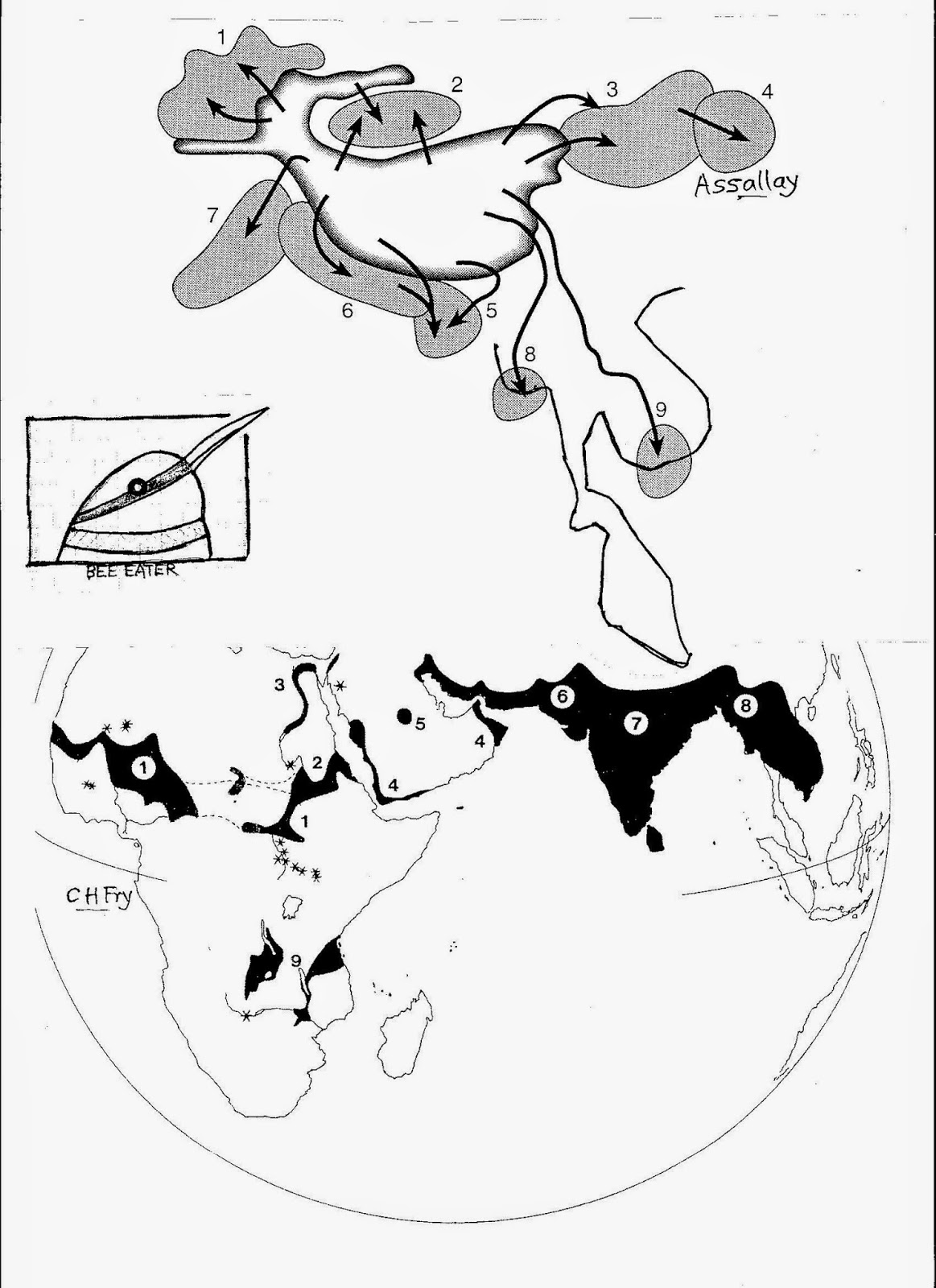
Pictures from Assallay et al (1998) and C.H.Fry (1984). The Assallay picture shows High Asia (it was based on the Alekseev-Dodonov map above)- the rivers indicated carry silt away from High Asia; the ones of immediate concern are rivers 8 and 9: the Irrawaddy and the Mekong. The local conditions inhibit loess deposit formation; the silt goes into bank deposits and delta deposits. So, abundant silt in S.E.Asia.
The Fry picture shows bee-eater nesting across Africa and Asia; not all bee-eaters- these are the data for the Little Green Bee-eater (Merops orientalis); 8 is Merops orientalis ferrugeiceps. Question: does the presence of High-Asia silt facilitate the nesting of the Little Gree Bee-eater in S.E.Asia?
The Little Green Bee-eater is perhaps not the best species to focus on in a study of the relationship of birds to ground. This is the smallest of the Bee-eaters (about the size of a sparrow) and it may be that its small size allows it to nest in grounds which are inaccessible to larger birds- as the Fry figure shows, it does have a wide distribution. No question of this bird being restricted to loess.