Ami Boue; a blog about Ami Boue [ami- short for Amedee; he was always called Ami Boue]. Born in Austria, spent time in France. Educated in Edinburgh, at the same time as Sam.Hibbert- and on the same course (medicine; some years ahead of CD). Much influenced by Robert Jameson, lecturer in mineralogy and long-time editor of the Edinburgh (New) Philosophical Journal. We are interested in Boue for several reasons- he is one of Lyell's loess team; one of the people listed by Lyell in PoG as having an interest in the loess of the Rhine valley. So he is a bona fide loess pioneer and it is possible that he made significant observations about the loess in the Danube basin. S.Z.Rozycki (1991, p.12) claimed that Boue (1836, 1838) established the presence of loess in the drainage basin of the middle and lower Danube. An interesting observation which is certainly not true because Murchison was reporting loess near Vienna in 1832 [in Trans.Geol.Soc.London 3 (ser.2) 301-420, 1832].

However we think he made significant observations of loess- before it became 'loess'. We go back to 1823; Boue submits a paper to his friend and mentor Robert Jameson in Edinburgh..
'Dear Sir: I have prepared a very full account... I remain your affectionate pupil. Vienna 24 Feb.1823. to Prof.Jameson, Edinburgh.
Boue, A. 1823. ART.XII- Outlines of a geological comparative view of the south-west and north of France, and the south of Germany. Edinburgh Philosophical Journal 9, 128-148.
"The alluvial matters are very abundant upon the base of the Pyrenees. They are divided into older, very much above the level of the present rivers; and into modern; and consist of pebbles, sand, rolled masses, marls with land-shells, like those found in Austria, and various tuffaceous calcareous rocks..
Great alluvial deposits, and accumulations of marl with land-shells, accompany the Rhine, and hide, at the base of the Kaiserstuhle, a basaltic group.. " [our emphasis]
'Marl with land-shells' what else can this be but loess? ; another description of the material that would become loess; another term to add to Mergel and Britz and Schneckenhausel-Boden. And, significantly Boue reports this proto-loess in the valleys of the Rhine, and the Danube.
Boue can be seen as a great generaliser; he wanted the big picture, the overview. He worked at producing geological maps of the world, and he liked the idea of basins. He was keen on basins. He had the loess in Europe deposited in vast lakes which were the basins of Europe. Hibbert (1832, p.185) reported that..
"The latest tertiary deposit which appears to have characterised the valley from Mayence to Basle has been properly considered by M.Boue as the product of a great freshwater sea that filled the whole basin of the Upper Rhine. It has been described under various names, of which the one most adopted is the of loess."
The Hibbert-Boue connection would bear more examination. It appears that they were exact contemporaries at Edinburgh University and attended the same classes and listened to the same lecturers. One imagines Boue and Hibbert sitting next to each other, listening to Robert Jameson expound upon the wonders of geology. Hibbert was great friends with Sir David Brewster, who was the driving force behind the Edinburgh Philosophical Journal. Brewster was present on the famous occasion when Hibbert's nighcap caught fire (but that's another story).
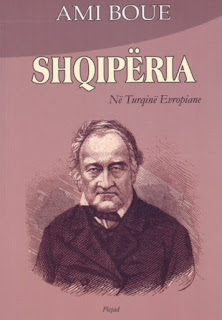
Boue produced the first geological map of New Zealand- and he did this without ever visiting the country. A true leap of the imagination. He did however make extensive voyages in south-eastern Europe, at the time when it was part of the Ottoman Empire. His lasting fame perhaps stands on his observations and writing on 'Turkey in Europe'..

Boue,A. 1840. La Turquie d'Europe ou Observations sur la Geographie, la Geologie, L'Histoire Naturelle, La Statistique, les Mouers, les Coutumes, L'Archeologie, L'Agriculture, L'Industrie, Le Commerce, Les Gouvernments Divers, Le Clerge, L'Histoire et L'etat Politique et cet Empire. Arthus Bertrand Paris 4 vols. vol.1 555p deals with geol.& geog.
Boue, besides fine titles had a good line in acknowledgements and he made mention of the various groups who had assisted him in his travels and labours..
"Nous avons voulu pouvoir causer a couer ouvert avec le grave at bon Ottoman, comme avec le spiritual Albanais, le fin Grec ou la ruse Valaque; avec le laborieux Bulgare, comme avec le belliqueux Serbe, le rustique Bosniaque ou le jovial Hertzegovinien."

Boue and Lyell. Boue was third on the list of people interested in loess in the Rhine Valley which Lyell constructed in vol.3 of PoG. [Leonhard, Bronn, Boue, Voltz, Steininger, Merian, Rozet, Hibbert, Noeggerath, Meyer, Horner}- these were people who, by and large, had written about the Rhine Valley deposits, and hence touched on loess. There was not much writing about loess as stuff, it was more loess as incidental. It may be significant that Boue is no.3, near the top of the list. Obvious why Leonhard & Bronn are top of the list; these are the heroes of Heidelberg, the 'onlie begetters' of the loess concept. Lyell knew Boue, he was aware of Boue; here he is on his way to the German Naturalists meeting in Bonn in 1835: he writes to Sedgwick from Paris-
"I found here Von Buch, E.de Beaumont, Dufresnoy, Constant Prevost, Virlet, Boue, Alex.Brogniart, and had much talk with all of them..
I am reading you and Murchison on the Eastern Alps, as I am going so near your section. Your elaborate joint paper is now quite a treat. Boue has given me many Gosau fossils. He is going to live four years in Vienna, and next year to do the Balkan. My wife says 'Give my kind regards to Mr Sedgwick, and tell him it is dreadfully hot'".
Note that reference to the paper by Sedgwick & Murchison:
Sedgwick,A., Murchison, R.I. 1832. A sketch of the structure of the eastern Alps, with sections from the newer formations on the northern flanks of the chain, and through the Tertiary deposits of Styria etc.etc. Transactions of the Geological Society of London 3 (ser.2) 301-420; with supplementary observations, sections, and a map by R.I.Murchison. doi:10.1144/transgslb.3.2.301
This was a vast paper; its very size may have caused relative neglect. In it, we think, is one of the very first definitive references to loess in the Danube basin- which did not escape the eagle eye of Leonard Horner- "In the synopsis of the successive deposits in the basin of Vienna, given by Mr.Murchison, the uppermost is described to be 'alluvial loam, called Loess, with terrestrial shells of existing species.. mixed with bones of elephants of extinct species.." that is Horner (1836) addressing the loess at Bonn.
Boue and Horner. The connection is not all that close- but interesting. Horner writes from Paris- he is on his way to the famous 1835 meeting in Bonn:
"I drove to the Geological Society, and found the clerk, who told me the address of M.Boue, near the Palais du Luxembourg. I found his house under repair, and after knocking at several doors came at last to the kitchen, wher I found Boue and his wife, both in dishabille, sitting at a table with bread, butter, greengages, peaches and wine, and the servant washing by their side. Boue recognized me at once, though he had not seen me for twenty years."
Twenty years- so 1815, when Boue was a student in Edinburgh. A geological meeting? had Horner known at the time that Boue was to be famous he would certainly have recorded it..
Balkan Boue.
Boue,A. 1837. Some observations on the geography and geology of northern and central Turkey. Edinburgh New Philosophical Journal 22, 47-61, 253-270.
"Another considerable basin, also higher than that of the Morava, extends from Turkish Banja, near Nissa [Nis] to Bulovan, and along part of the course of the Morava and Topolitza. South of Nissa it is alluvial as well as tertiary, having marls and molasses with sands above, and lastly alluvial loam or loess." (1837,p263)

However we think he made significant observations of loess- before it became 'loess'. We go back to 1823; Boue submits a paper to his friend and mentor Robert Jameson in Edinburgh..
'Dear Sir: I have prepared a very full account... I remain your affectionate pupil. Vienna 24 Feb.1823. to Prof.Jameson, Edinburgh.
Boue, A. 1823. ART.XII- Outlines of a geological comparative view of the south-west and north of France, and the south of Germany. Edinburgh Philosophical Journal 9, 128-148.
"The alluvial matters are very abundant upon the base of the Pyrenees. They are divided into older, very much above the level of the present rivers; and into modern; and consist of pebbles, sand, rolled masses, marls with land-shells, like those found in Austria, and various tuffaceous calcareous rocks..
Great alluvial deposits, and accumulations of marl with land-shells, accompany the Rhine, and hide, at the base of the Kaiserstuhle, a basaltic group.. " [our emphasis]
'Marl with land-shells' what else can this be but loess? ; another description of the material that would become loess; another term to add to Mergel and Britz and Schneckenhausel-Boden. And, significantly Boue reports this proto-loess in the valleys of the Rhine, and the Danube.
Boue can be seen as a great generaliser; he wanted the big picture, the overview. He worked at producing geological maps of the world, and he liked the idea of basins. He was keen on basins. He had the loess in Europe deposited in vast lakes which were the basins of Europe. Hibbert (1832, p.185) reported that..
"The latest tertiary deposit which appears to have characterised the valley from Mayence to Basle has been properly considered by M.Boue as the product of a great freshwater sea that filled the whole basin of the Upper Rhine. It has been described under various names, of which the one most adopted is the of loess."
The Hibbert-Boue connection would bear more examination. It appears that they were exact contemporaries at Edinburgh University and attended the same classes and listened to the same lecturers. One imagines Boue and Hibbert sitting next to each other, listening to Robert Jameson expound upon the wonders of geology. Hibbert was great friends with Sir David Brewster, who was the driving force behind the Edinburgh Philosophical Journal. Brewster was present on the famous occasion when Hibbert's nighcap caught fire (but that's another story).
Boue produced the first geological map of New Zealand- and he did this without ever visiting the country. A true leap of the imagination. He did however make extensive voyages in south-eastern Europe, at the time when it was part of the Ottoman Empire. His lasting fame perhaps stands on his observations and writing on 'Turkey in Europe'..

Boue,A. 1840. La Turquie d'Europe ou Observations sur la Geographie, la Geologie, L'Histoire Naturelle, La Statistique, les Mouers, les Coutumes, L'Archeologie, L'Agriculture, L'Industrie, Le Commerce, Les Gouvernments Divers, Le Clerge, L'Histoire et L'etat Politique et cet Empire. Arthus Bertrand Paris 4 vols. vol.1 555p deals with geol.& geog.
Boue, besides fine titles had a good line in acknowledgements and he made mention of the various groups who had assisted him in his travels and labours..
"Nous avons voulu pouvoir causer a couer ouvert avec le grave at bon Ottoman, comme avec le spiritual Albanais, le fin Grec ou la ruse Valaque; avec le laborieux Bulgare, comme avec le belliqueux Serbe, le rustique Bosniaque ou le jovial Hertzegovinien."

Boue and Lyell. Boue was third on the list of people interested in loess in the Rhine Valley which Lyell constructed in vol.3 of PoG. [Leonhard, Bronn, Boue, Voltz, Steininger, Merian, Rozet, Hibbert, Noeggerath, Meyer, Horner}- these were people who, by and large, had written about the Rhine Valley deposits, and hence touched on loess. There was not much writing about loess as stuff, it was more loess as incidental. It may be significant that Boue is no.3, near the top of the list. Obvious why Leonhard & Bronn are top of the list; these are the heroes of Heidelberg, the 'onlie begetters' of the loess concept. Lyell knew Boue, he was aware of Boue; here he is on his way to the German Naturalists meeting in Bonn in 1835: he writes to Sedgwick from Paris-
"I found here Von Buch, E.de Beaumont, Dufresnoy, Constant Prevost, Virlet, Boue, Alex.Brogniart, and had much talk with all of them..
I am reading you and Murchison on the Eastern Alps, as I am going so near your section. Your elaborate joint paper is now quite a treat. Boue has given me many Gosau fossils. He is going to live four years in Vienna, and next year to do the Balkan. My wife says 'Give my kind regards to Mr Sedgwick, and tell him it is dreadfully hot'".
Note that reference to the paper by Sedgwick & Murchison:
Sedgwick,A., Murchison, R.I. 1832. A sketch of the structure of the eastern Alps, with sections from the newer formations on the northern flanks of the chain, and through the Tertiary deposits of Styria etc.etc. Transactions of the Geological Society of London 3 (ser.2) 301-420; with supplementary observations, sections, and a map by R.I.Murchison. doi:10.1144/transgslb.3.2.301
This was a vast paper; its very size may have caused relative neglect. In it, we think, is one of the very first definitive references to loess in the Danube basin- which did not escape the eagle eye of Leonard Horner- "In the synopsis of the successive deposits in the basin of Vienna, given by Mr.Murchison, the uppermost is described to be 'alluvial loam, called Loess, with terrestrial shells of existing species.. mixed with bones of elephants of extinct species.." that is Horner (1836) addressing the loess at Bonn.
Boue and Horner. The connection is not all that close- but interesting. Horner writes from Paris- he is on his way to the famous 1835 meeting in Bonn:
"I drove to the Geological Society, and found the clerk, who told me the address of M.Boue, near the Palais du Luxembourg. I found his house under repair, and after knocking at several doors came at last to the kitchen, wher I found Boue and his wife, both in dishabille, sitting at a table with bread, butter, greengages, peaches and wine, and the servant washing by their side. Boue recognized me at once, though he had not seen me for twenty years."
Twenty years- so 1815, when Boue was a student in Edinburgh. A geological meeting? had Horner known at the time that Boue was to be famous he would certainly have recorded it..
Balkan Boue.

Boue,A. 1837. Some observations on the geography and geology of northern and central Turkey. Edinburgh New Philosophical Journal 22, 47-61, 253-270.
"Another considerable basin, also higher than that of the Morava, extends from Turkish Banja, near Nissa [Nis] to Bulovan, and along part of the course of the Morava and Topolitza. South of Nissa it is alluvial as well as tertiary, having marls and molasses with sands above, and lastly alluvial loam or loess." (1837,p263)


