V.I.Krokos 1889-1936

Deptford Station was on the London to Greenwich Railway; the first of the London railways (opened 1836-1838). Much of the railway was on a large brick viaduct (of 878 arches) which was built from London Stock bricks obtained from Faversham. These were shipped up the river in barges and unloaded at the Deptford Creek. Much building and rebuilding has occurred since 1838 but some very old bricks are still visible at Deptford Station.

The repointing is fairly modern but these are old stock bricks, classic hand made bricks. The red bricks are much later additions.

In 1944 Alfred Kennard published, in the Proceedings of the Geologists Association, a sketch map of the Crayford Brickearths region. There is growing interest in the UK loess so it seems like a good idea to publish a slightly updated version of the Kennard map. The revisions were done by Kerry Allen at the University of Leicester Cartographic Unit; a discussion of the new map will be published in British Brick Society Information.

https://buildinglondon.blog
no.41: London's Yellow Stock Brick
a blog by Glyn Harries published 12 July 2022
A long, beautifully illustrated blog about London Stock Bricks- and how they are made from Loess. Glyn is very careful to discuss the various suggestions that London Clay was involved in the making of LSB but he comes down on the side of Loess. This blog, no.41, has been republished on the Loess Appreciation Group website.


Marks Tey brick kiln (in Essex) . Marks Tey is one of the few brickfields where we have information about the local brickearth. Grenville Lill in his Leeds U PhD thesis managed to get Marks Tey samples and do some useful thermogravimetric analyses.
The Commission on Childrens Employment investigated the brickyards of Crayford in 1864-1865. A major report was presented to Parliament in 1866. Two Crayford brickyards were reported on: D & C Rutter, and Lucas, Brothers. D & C Rutter were a well known enterprise and traces of their Crayford activities remain. Rutter's pit is marked on the Kennard map of the Crayford brickearths.
Lucas, Brothers presents problems. It is difficult to find traces of their activities in Crayford. Its hard to believe that the Commissioners misplaced the Lucas, Brothers operation but they do not appear in the Crayford section of Kellys Directory of Kent 1862. The 1866 Report of the Commissioners has a substantial section on Lucas,Brothers:
Reports from Commissions v.24
Crayford Messrs Lucas, Brothers. In the summer of 1864 there were 112 persons employed here; one girl and three boys under 13 years old; six girls and eleven boys between 13 and 18; and six females over 18. Mr H.W.Lord reports.
Mr.Nevill (manager?) reports- The children are employed at the stools with the brick moulders, they are frequently the children of the moulder or some other person in the gang but not always so. We have 52(maybe 32 - report indistinct at this point) stools; there are usually seven persons to each; the children are either barrow loaders or pug boys; the pug boy carries the clay in his arms from the pug mill to the moulder; sometimes a man has two small pug boys of ten tears old or so, instead of one older one; one of these two cuts the clay as it comes from the bottom of the pug mill with a kind of flat fork, which they call a 'cackle'; the barrow loader is often a girl . The clay is prepared for the moulder by a 'walk flatter', who stands by the moulders side, and receives the clay from the pug boy; that is often done by women. The bricks weigh 8 lbs each, there are 28 bricks loaded on each barrow before it is wheeled off; the 'pushers-on' (that is those who wheel off) are usually men.
Mr.Lord reports' I went with Mr Nevill to every stool in both the brickfields worked by Messrs Lucas'. So- two brickfields but where and which? And what do we know about Lucas Brothers? A Construction company; founded in 1842, defunct in 1895. Built Albert Hall (1871) Covent Garden Opera House (1858) Charing Cross Station (1864) Cliveden (1851), Charterhouse School, Woolwich Arsenal ? If their brickworks were operating in 1864 it suggests that maybe Craford bricks were used in the construction of Charing Cross Station; not far by barge from Crayford to the Charing Cross site. But why is there no record of their operations at Crayford? D & C Rutter- well recorded- no records of Lucas Brothers.

An explanation of the Lucas Bros anomaly: There was a typographic error in the Commission report and this resulted in the Lucas Bros operation being classified under Crayford rather than Faversham. The Crayford marker in the text was slightly misplaced making Lucas Bros appear in Crayford rather than Faversham; investigations by Mr.J.Howarth of Erith show Lucas Bros listed in the Kellys Directories for 1874 and 1882 and located at Teynham (near Murston, near Sittingbourne, near Faversham). In 1874 near Crayford there were Rutter D & C at Crayford, Furners at Slade Green, Erith, Dawson at Plumstead Common & Wickham Lane, White John Bazley Bros at Swanscombe, Dartford, Greenhithe & Erith.
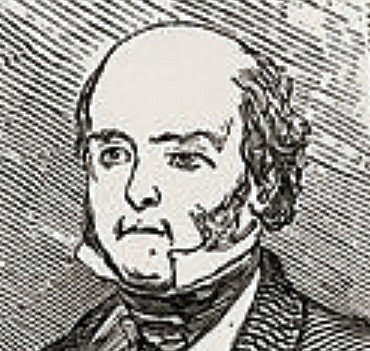
There are not many pictures of Leonard Horner around- he was famous but not particularly famous. He was one of the few people mentioned by name by Karl Marx in 'Das Kapital'- for his work trying to improve conditions of working children in Victorian Britain. His great love was geology, and his best moments were the few years he spent in and around Bonn, in 1831-1833. While the Horner family were in Bonn they were visited by Charles Lyell, who came to see the remarkable geology- and to marry the oldest Horner daughter Mary. Horner & Lyell explored the crater of the Rodderberg, and examined the loess that it contained.
Horner presented a paper on 'The Geology of Bonn' to the Geological Society in London in 1833- it was published in 1836. One of the first papers on loess in English; a useful complement to Lyell's 1834 Edinburgh paper. For more about Horner and loess read Smalley (2020) and/or Smalley & Markovic (2018).
Smalley, I.J. 2020. Leonard Horner in Bonn 1831-1833, finding loess and being incorporated into Lyell's Loess Legion. GeoLogos 26, 163-170.
Smalley, I.J., Markovic, S.B. 2018. An enthusiasm for loess: Leonard Horner in Bonn and Liu Tung-sheng in Beijing. Open Geosciences 10, 925-931.
Loess200*2024


This is North End Erith 1897; brickearth workings. Two brickworks in action here; this is 1897 so the pug mills are connected to engine houses. Tracks are visible to move brickearth from the excavation face to the vicinity of the pug mill. There are connections to the Crayford-Erith road which would allow access to Erith dockside.
 |
| North End Erith 1897 Map |
There was a modest loess fall over south-eastern England in around 20,000 BP. Thats a very rough date, and there were in fact two loess falls, with a short interval in-between, which had some effect on geomorphology and life in southern England. Loess provides agricultural enhancement so farming improved over a substantial area, an admixture is almost as good as a large loess-fall. This loess would provide material for the making of bricks and for most of the nineteenth century (particularly the early parts) it provided material for the bricks to build London. Many brickpits were opened, mostly small scale enterprises but some large and very productive such as Smeed-Deans at Murston near Faversham. One significant concentration of brick making material was at Crayford in north-west Kent; here the Crayford Brickearths were used, and for many years geologists sought Pleistocene fossils; the brickpits were great sources of material for geologists and collectors.

Map from Kennard (1944) pits labelled as W Whites, N Norris, F Furners, R Rutters, S Stoneham

The bricks to make Victorian London have been discussed by Peter Hounsell in his recent book (Bricks of Victorian London. University of Hertfordshire Press Hatfield 283). This is more of a social history than a text on brick manufacture, but Crayford does feature 13 times in the index (on pages 19 30 36 39 68 83 112 132 134 135 159 160 and 161). Most writing about Crayford is by the geologists and palaeontologists; the brick pits were very popular in the nineteenth century and much visited by Geologists Association excursions; the opening of Slades Green station on the South Eastern Railway in 1900 facilitated latter day visiting; the station opened as Slades Green but the name was changed to Slade Green in 1953.
The Benchmark paper on the Crayford Brickearths is Kennard (1944)- this discussion largely revolves around this paper. The title quotation comes from here (p.122).
"Thames reds" have given place to "Flettons" Kennard demarcates the ending of brick production in Crayford and the overwhelming arrival of the Fletton machine-made bricks. Kennard collected at Crayford between 1892 and 1900 and observed the decline of the industry.
Alfred Santer Kennard 1944. The Crayford Brickearths. Proceedings of the Geologists Association 55, 121-167. The definitive map is by Kennard- see above, related to relevant OS map.
That short quote is critical. Most of the paper is given up to fossil collecting and Pleistocene geology; there is a small part on actual bricks and brickpit geography. The quote suggests that Crayford was producing bricks that fired to red-the Thames Reds, which must mean that no chalk admixtures were used, and perhaps no spanish. There appears to be no records of spanish being used in the Crayford bricks. The great source of brickearth bricks was further down the river, at Smeed Dean at Murston. These bricks fired to yellow- the famous yellow of the London Stock brick. The yellow colour was obtained by adding chalk; the other key admixture was the so-called 'spanish' which was a mixture of cinders and ashes from London's rubbish. This made firing more economic by providing an internal fuel source. As Nature obligingly did with the Flettons, from the midland clays.

Whitaker, W. 1889. The Geology of London and of parts of the Thames Valley (Explanation of Sheets 1, 2 and 7). Memoirs of the Geological Survey of England and Wales. HMSO London 556p. POD book by Forgotten Books; copy from Harvard University
p.432. Prof. Morris seems.. to have been the first to describe the great sections of Erith and Crayford.. Unfortunately, of the four sections described in this paper, the precise locality of only one, near Crayford [Stonehams] is given; though presumably the others follow on in order, northward, to Erith.
p.436. At Northend, on the southern side of Colyers Lane, a new pit has been opened [Norris pit] since the six inch ordnance map was made, a little south of the Erith pit, and just NW of the Happy Home Inn. It was carried down to a depth of from 35 to 40 feet (in 1887), being deepest on the west.
p.439. When I last saw the Crayford section [Stonehams], in the summer of 1888, the northern part had been cut back much further, even to touching the road [Howbury Lane-near Slade Green], by Manor Farm.
Words associated with Loess; words belonging to the world of Loess; words that need explaining- and could benefit from some discussion; words that might be deployed more widely.


Loessification L.S.Berg 1964 Loess as a Product of Weathering and Soil Formation. Israel Program for Scientific Translations Jerusalem 207p translated from the Russian by A.Gourevitch. This is now the basic Berg reference; most of his work was published in Russian and is now hard to find. The 1964 book is translation of material from 1947; from Berg 1964 p.20:
"The difference between loess and its parent rock is like the distinction between soil and rock: the transformation of the latter into the former requires a soil-forming process; in the same manner, the transformation of rock into a loess requires a loess-forming process. The process, though variable in each instance, is everywhere the same in its principle; it is a 'loessification' ; and from this standpoint we are justified in assuming a single family of loessic rocks."
Collapsibility
Chernozemisation
Adobe
Brickearth 
Silt
Dictionaries. Heinemann New Zealand Dictionary 1979: loess (say lerss) noun; a loose, usually yellowish, deposit of wind-blown soil, particularly common in China. (German)
Cavitation
Suspension
Verbreitung
Comminution
Heneberg compromise

Schneckenhausel Boden Sam.Hibbert, in 1832, wrote about the naming of Loess.. "It has been described under various names, of which the most adopted is that of Loess. According to M.Von Leonhard, its synonyms, as they occur along the course of the Rhine, are Loesch, Schneckenhausel-Boden, Mergel, (in the upper lands of Boden,) and Briz."
Mergel
Briz
Parna
Mercia Mudstone
Windy Day
Loess Commission INQUA The Loess Commission was founded by Julius Fink (a professor in Wien in Austria) he founded it initially as a sub-commission of the Stratigraphy Commission of INQUA (Internationale Quartarvereinigung)[for data on INQUA see Loess Letter 65]- at the 1961 meeting of INQUA in Poland; at the Paris INQUA Congress of 1969 it was upgraded to full commission status; Fink stayed as President. He handed over to Marton Pecsi of the Hungarian Academy of Sciences in 1977 at the UK Congress.
Hydroconsolidation


Ward Chesworth 1982 Late Cenozoic Geology and the Second Oldest Profession. Geoscience Canada 9(1) 54-61
Geological disturbance leads to good soils (rich in nutrients)- glaciation leads to loess - and good soils.


Professor James Maurice Bowler OA FRSV b.1930 Geomorphologist/ Archaeologist/ Campaigner

Jim Bowler. educated at The University of Melbourne BSc 1958; MSc in 1961; then on to ANU in Canberra for a PhD. To ANU in 1965; PhD 1970 (or 1971)
Bowler, J.M. 1971. Late Quaternary Environments: A study of lakes and associated sediments in South Eastern Australia. PhD thesis ANU Canberra
Bowler, J.M. 1973. Clay dunes: their occurrence, formation and environmental significance. Earth Science Reviews 9(4), 315-338.
PhD at ANU. He was directed towards the Willandra Lakes region by Joe Jennings. JJ was a reader at ANU; he moved to ANU from Leicester University in 1952. He left Leicester just around the time when Norman Pye was being appointed Professor of Geography and Head of the Geography Department. He had carried out some very successful studies on the Norfolk Broads but chose to abandon this wet region of Eastern England for the drier regions of Australia. One day when he was flying from Broken Hill to Sydney he noticed some interesting aspects of the Willandra Lakes region- a series of dry lakes showing some interesting geomorphology. When JB turned up needing a PhD topic he was guided towards the Willandra Lakes region and, riding his motor-cycle there in 1968 he discovered the remains which eventually became known as Mungo Lady. Named after Lake Mungo- a name which JB bestowed on the critical lake.
JJ went on the Australian Academy trip to China in 1975; one speculates that he was responsible for JB going as well; JB was a relatively junior ANU person but JJ was probably influential enough to request his presence.

Lake Mungo is in the Willandra National Park, 300+km from the Australian Capital Territory.
Australian Quaternary Studies: A tribute to Jim Bowler. J. Magee, P. De Deckker eds Quaternary International 83-85, 1-292. 11 Sept 2001
J.Magee, P. De Deckker pp.1-4. Jim Bowlers contribution to Australian Quaternary Studies.
Liu Tungsheng.(1917-2008) Liu Tungsheng- the doyen of Chinese loess investigators. The 1975 encounter with JB and the rest of the Australian party had a major effect on the life and career of Liu Tungsheng. His interest in loess had been waning in the aftermath of the Cultural Revolution but it was revived by the requirements of the visit. Liu, in preparing material for the loess excursions, found his interest rekindled and his life work re-energised. Bowler was determined to spread the word on Chinese loess and to promote loess studies and for several years he and Liu cooperated on these projects.
Yuhong Zhang, Li Guan, Qiang Liu 2018. Liu Tungsheng: a geologist from a traditional Chinese cultural background who became an international star of science. Journal of Asian Earth Sciences 155, 8-20.

Bowler, J.M. 2009. Interview with Professor Liu Tungsheng (conducted in October 2004 in Beijing). J.M.Han et al (eds) Memory of Tungshen Liu. Commercial Press Beijing (in Chinese, original articles in English included) ISBN 978 7 100 06571 9)
"In a rare interview between two academic friends from two different countries, James Bowler (from Australia) and Liu Tungsheng, two great masters of science, conducted an intensive dialog about Quaternary Science, and its past, present and future prospects" (Zhang et al 2018)
A quote from Liu: "So 1975 was the turning point for renewing my (loess) studies, otherwise I may have continued to work on other environmental issues."
Loess Commission. The INQUA Congress in 1977 was held in Birmingham UK. This was an important moment for the Loess Commission. The President, Julius Fink of the University of Vienna, handed over to Marton Pecsi of the Hungarian Academy of Sciences, and the Commission took on a 'new look'. The Commission was founded as a full commission in 1969 (at the Paris INQUA Congress);up to then it had functioned as a sub-commission of the Stratigraphy Commission and had focussed its investigations mainly into Central and Eastern Europe. Pecsi wanted to broaden the scope so he determined that the new look Loess Commission should look at world-wide loess deposits and should extend the field of studies into applied regions; engineering geology and ground engineering were valid topics. This expansion came at an ideal time for JB because he proposed that a 'Western Pacific Working Group' be founded which would concentrate on loess deposits in the Western Pacific region i.e. China, Australia and New Zealand. This was his way of promoting the loess deposits in China and supporting his friend Liu Tungsheng. The WPWG was announced in Birmingham in 1977 and functioned for about 10 years. In the INQUA system working groups were supposed to be set up to consider specific problems, and to run for limited periods.
Next, on to the ANZAAS conference in Auckland in early 1979. The Australia and New Zealand Association for the Advancement of Science met in Auckland and this was chosen as the official launching point for the WPWG. There were no Chinese delegates present but the Australian and New Zealand delegates decided on a programme and a plan of action. Three field trips would be held- in China, Australia and New Zealand- these would be discussion trips like those Fink organised in the early days of the Commission. The first would be in Australia in 1980; the New Zealand group would organise a newsletter to record the activities and spread the word.

The newsletter was to be Loess Letter, which was first published in 1979; to appear twice a year. The early issues contain details of the setting up of the WPWG and give some details of the discussions which JB had in Beijing organising the Chinese involvement. Liu Tungsheng visited the NZ Soil Bureau in 1980 and wrote the title. Also in 1980 was the first WPWG field trip to S.E.Australia. Logically enough to the JB field area in the Willandra Lakes region, to see the aeolian landforms, to admire the'walls of China'- to actually fly in a light plane over Lake Frome and the edge of the Flinders range- and to have dinner in Broken Hill with Bruce Butler. The Chinese delegation should be recorded: Liu Tungsheng, Wu Zirong, Yuan Baoyin, Zheng Honghan, An Zhisheng & Wen Qizhong. A proceedings volume edited by Bob Wasson (mostly of CDU) was produced.
The next WPWG meeting was in China in 1985 and by then the whole world had changed. Chinese loess research had made a quick recovery and the first steps were being taken towards the huge effort and output of today. The meeting in China was a major conference; the proceedings volume contained 85 titles + a large book of 43 papers. The JB initiative had succeeded; there was indeed great interest in the Chinese loess. New Zealand in 1987; the third and last of the WPWG meetings; starting in Christchurch and heading north to Auckland. A conference volume was produced- which was summarised in Loess Letter 21 and carefully reviewed by Ed Derbyshire in PPG. The Loess Letter timing was fortuitous, LL21 was the tenth anniversary issue, the WPWG had been running for just ten years. JB may not have been the 'onlie begetter' but he was largely responsible.
Derbyshire, E. 1990. Book Reviews: Eden, D.N., Furkert, R.J. eds. 1989. Loess: its distribution, geology and soils. Balkema Rotterdam. Progress in Physical Geography 14, 569-571.
Commentary. Rarther ironic that there is little loess in Australia; this remarkable loess based enterprise (the WPWG) was definitely aimed at China. Lucky that NZ was to hand to provide some real loess and to give the loess project a respectably loessic appearance. The granular landforms in S.E. Australia are great and granular but lacking in clastic material. This is the land of the clay-mineral-aggregate- the 'parna' which Bruce Butler described. The CMA material can behave like loess,. and larger CMA can behave like sand- this is a region where ideas can come together. The rainbowbirds can show us where loess-like material is to be found.
Ian Smalley 1977. New look for the Loess Commission. Nature 270, 300 only.
Ian Smalley, Slobodan Markovic, Ken O'Hara-Dhand 2010. The INQUA Loess Commission as a Central European enterprise. Open Geosciences 2(1), 3-8.
Ian Smalley, Ken O'Hara-Dhand 2010. The Western Pacific Working Group of the INQUA Loess Commission: expansion from Central Europe. Open Geosciences 2(1), 9-14.
Ian Smalley, Sue McLaren, Ken O'Hara-Dhand 2015. Loess and bee-eaters 4: Distribution of the Rainbowbird (Merops ornatus Latham 1801) in Australia. Quaternary International 399, 230-235.

salute JB!

Professor Edward Derbyshire: b.18 August 1932: Physical Geographer/ Loess Scholar
Encounter. This is the story of a fateful encounter; an important moment in an academic life- which had considerable geoscientific consequences and affected many careers. The encounter took place in 1977 when ED went to China with a delegation from the Royal Society. The purpose of the visit was to re-establish scientific contacts which had been degraded during the Cultural Revolution in China. The Cultural Revolution lasted roughly ten years, from 1966 to 1976; by 1977 moves were afoot to restore some of the damage which had been caused. The Royal Society party visited the Loess Regions and ED encountered the Loess. He was impressed. A similar party from the Australian Academy of Sciences also visited the loess regions and Jim Bowler was similarly impressed. Both Bowler and ED, being people of action, set about developing their relationships with this amazing material/landscape. Bowler set up the INQUA Western Pacific Working Group to promote loess research in China, Australia and New Zealand, and ED developed a close relationship with workers in Lanzhou, particularly Wang Jing tai and set about planning a project to investigate landslides in the loess in the Lanzhou region.
ED 1983 The loess at Jiuzhoutai, Peoples Republic of China - a note. Loess Letter 9, 10-13 [see www.loessletter.msu.edu]- one of the first responses to the encounter.
ED address given as: Soils Research Laboratory, University of Keele, Keele, Staffs. ST5 5BG, England. Some of the very early ED loess literature belongs to Keele but most of the loess activity is associated with Leicester University.
Keele. In 1977 ED was reader in the Geography Department at the University of Keele; he had a long relationship with Keele University and possibly, when the ossified structure in the Geography Department at Leicester was proving difficult to shift, regretted leaving. ED was a student at Keele: BA 1954, and he returned, after various adventures in Canada and Australia as a Lecturer in 1966. He remained as a lecturer until 1970 and was then promoted to senior lecturer; then to reader in 1974. He stayed as reader until 1984 and was then (belatedly he thought) promoted to professor. But he had decided to leave (feeling unappreciated) and moved to Leicester in 1985.
Leicester. Norman Pye had been Professor of Geography and Head of Department at Leicester from 1954 to 1979; it had become a very Pye-like department, a certain Pye-crust had developed- essentially the old style traditional geography so the Pye successor was going to face multiple tasks. ED was appointed in 1985 and set about developing a modern department, and setting up the Loess Landslides in Lanzhou project. The key co-developer was Wang Jingtai at the Disasters Research Institute in Lanzhou and on a visit to York University in Toronto he met Ian Smalley who agreed to come to Leicester and join the enterprise. A certain symmetry here; Smalley had worked with Jim Bowler setting up the Western Pacific Working Group and was publishing Loess Letter so it was fitting that he moved to Leicester to work with the other China inspired operative on another aspect of loess research.
A great setback early on; the landslides project depended on soil mechanics testing and the Leicester University Engineering Department was due to provide access to their well equipped soil mechanics laboratory to cover this aspect of the work. The Leicester Engineering Department was a combined department, it included Civil, Mechanical and Electrical Engineering and in the mid-1980s the Electrical Engineering section was perceived as performing rather badly, and the strange response to this was to close the Civil Engineering Section so that resources could be concentrated on Electrical Engineering, which was seen as being more important and promising for the future. So, at a stroke, the soil mechanics laboratory was lost and the project appeared to be mortally wounded.
On a morning in November 1989 Tom Dijkstra and Ian Smalley drove north from Leicester heading for Loughborough. The purpose was to visit Loughborough University and make contact with the soil mechanics people and possibly enlist their help- to replace what had been lost by the Leicester Civil Engineering closure. The key person in Loughborough soil mechanics turned out to be Dr.Chris Rogers, and he agreed to cooperate. By a lucky chance Dr Rogers had been a student at Leeds University and had been taught ground stuff by Ian Smalley- so a link already existed. And the timing was good; Loughborough CED wanted a bit more exposure and the prospect of joint papers was attractive; thus was initiated a fruitful Leicester-Loughborough link which did in fact lead to some useful and much cited papers. A direct result of the loess cooperation was the default paper on hydroconsolidation and subsidence in loess:
Rogers, C.D.F., Dijkstra, T.A., Smalley, I.J. 1994. Hydroconsolidation and subsidence of loess; Studies from China, Russia, North America and Europe. Engineering Geology 37, 83-113.
Landslides in Lanzhou. Government of Gansu Province/ Commission of the European Communities: Research & Control of Landslides and Debris Flows in the Loess Region of Gansu Province, China; Contract no. CI.1.0109. U.K.(H)
ED, Wang J T 1988. EC launches project on landslides and debris flows in Chinese loess. Episodes 11, 131-132
NATO: Collapsing Soils at Loughborough. A spin-off from the main loess project was the meeting in Loughborough in 1995 to discuss loess and other collapsing soils. Support from NATO enabled several very important scholars to attend- including George Kukla, Richard Handy and Jaroslav Feda. A very handsome book was published by Kluwer in 1995, and reprinted in paperback by Springer in 2012..

LoessFest 1999. Ludwig Zoeller suggested that a loess conference be held to celebrate the 175th anniversary of the description and naming of the loess by Karl Caesar von Leonhard in Heidelberg in 1824. This idea was taken up by ED and eventually a great conference, a LoessFest, was held in Heidelberg and Bonn in 1999.
Begin in Heidelberg; visit Haarlass- the locus typicus for loess, this is KCvL country. Samples distributed and certificates of authenticity. On to Bonn for the papers and presentations. Most of the delegates stayed at a hostel out in Venusberg (this could be the Venusberg where Tannhauser met Venus and they enjoyed some quality time in each others company).
ED (ed) 1999. LoessFest 1999 Proceedings. Loess: Characterization, Stratigraphy, Climate and Societal Significance. 272p.
.jpg)
People at LoessFest: thats Ludwig Zoeller on the extreme left, he sets one limit; thats Ed Derbyshire on the extreme right sitting on the pillar, he sets another limit. Ian Smalley is more or less in the middle, bald head, beard, light coloured jacket -on his right with blue shirt and offering profile is Tom Dijkstra. Behind the TD right shoulder is Andre Dodonov. One day we will contrive a proper outline and numbering system and get everyone identified. Steve Porter in front of the ED pillar; we are all standing outside the Geographical Institute of the University of Bonn.

Big Book 2000. The climax of the Loess Landslides in Lanzhou project:
Landslides in the Thick Loess Terrain of North-West China. eds. ED, Xingmin Meng, Tom Dijkstra. John Wiley Chichester 288p. 2000. [Library of Congress gives 1999, but the copyright mark is 2000] ISBN 0471 97349 1.
ED@80. A tribute to ED's loessic endeavours- particularly in China
Loess in China and Europe: a tribute to Edward Derbyshire. 2014. eds.Slobodan Markovic, Shiling Yang, Norm Catto, Tom Stevens. Quaternary International 334-335. 17June 2014
Loess and dust dynamics, environments, landforms, and pedogenesis: a tribute to Edward Derbyshire. eds. Slobodan Markovic, Lewis Owen. Catena 117, 157p.
Commentary. A beginning and an end. A definite, easily defined beginning, and an arbitrary end. The ED@80 meeting in Novi Sad in 2012 was a very substantial marker of the progression of ED on the great loess journey. Of course he went on to do many useful and significant things but ED@80 was a neat indicator of a remarkable project carried out with great skill and determination and producing some excellent results.
John Hardcastle, encountered on 19th January 1979, a warm summer day in Lower Hutt. The meeting took place in the library of the NZ Soil Bureau on Eastern Hutt Road, Taita, Lower Hutt NZ. Present JH, Jewel Davin, Ian Smalley.

That was a Friday, only three days before the start of the 49th ANZAAS Conference in Auckland, where there were more encounters: Jim Bowler, Jane Soons, Alan Pullar and various other noteables. Bowler was on site to kick start the Western Pacific Working Group of the INQUA Loess Commission- so it was an important meeting. JH was there in spirit.
JH was revealed by the initial searches for material for BR28- the NZ Loess Bibliography. Up to 1979 he had been an obscure provincial scholar- after 1979 he was revealed as a significant loess thinker, one of the key investigators in NZ into matters loessic; in fact he became a world figure as the inventor of loess stratigraphy- the person who described loess as a 'register of climate change'.
John Hardcastle 1908. Notes on the Geology of South Canterbury. Timaru Herald, Sophia Street Timaru 62p. New edition published as Loess Letter Supplement ns2 June 2014 Leicester University
Roger Fagg 2001 John Hardcastle (1847-1927) -a gifted amateur. Geological Society of New Zealand Historical Studies Group Newsletter 22, 21-25.
Roger Fagg Ian Smalley 2019 Loess in New Zealand: Observations by Haast Hutton Hardcastle Wild and Speight 1878-1944. Quaternary International 502A 173-178.
Roger Fagg Ian Smalley 2018 'Hardcastle Hollows' in loess landforms: closed depressions in aeolian landscapes- in a geoheritage context. Open Geosciences 10, 58-63.
JH 1899 Origin of the loess deposit of the Timaru plateau. Transactions and proceedings of the New Zealand Institute 22, 406-414 [reprinted in Loess Letter 71 www.loessletter.msu.edu ]
JH 1890 On the Timaru loess as a climate register. ibid 23, 324-332 [reprinted in LL71]
Ian Smalley 1983 John Hardcastle on glacier motion and glacial loess. Journal of Glaciology 29, 480-484 [reprinted in LL71]
Ian Smalley Roger Fagg 2014 John Hardcastle looks at the Timaru loess; climate signals are observed, and fragipans. Quaternary International 372, 51-57.
Ian Smalley Ian Jefferson Tom Dijkstra Edward Derbyshire 2001. Some major events in the development of the scientific study of loess. Earth Science Reviews 54 5-18 [section on JH].

Christchurch Star 3 October 1890:
An ordinary meeting of the Philosophical Institute of Canterbury was held in the Public Library last evening. There was a moderate attendance, the President, Mr.J.T.Meeson, in the chair. .. The Secretary read a paper by Mr.J.Hardcastle of Timaru, on "The Loess of Timaru as a Climate Register". He stated his conclusion that the loess is a formation of wind-blown dust belonging to the second glacial period, and contains bands, which mark pauses in the process of deposition, which are interpreted as registers of considerable variation of climate within that period.
Jewel Elizabeth Davin 1945-2014; Librarian at the DSIR Soil Bureau HQ at Taita, Lower Hutt, New Zealand. Jewel was librarian in 1978 when Ian Smalley arrived from the University of Leeds to undertake his study of the New Zealand loess. Jewel had been the only Soil Bureau bibliographer but suddenly another one appeared- there followed a few years of interesting bibliographical activity.
When Ian Smalley arrived in New Zealand he carried with him the almost completed text of the loess bibliography which he was preparing for the Geo Abstracts bibliography series. This was an INQUA operation and earlier drafts had been tested on Marton Pecsi and Dan Yaalon. It was completed in New Zealand and published from the Soil Engineering Section. It was a general bibliography, covering all aspects of loess investigation. Particular attention was paid to loess studies in Russian; it was felt that loess studies in Russian had been neglected. The timing was good- this set the scene for the two Smalley-Davin New Zealand bibliographies.
LPB- Ian Smalley 1980 Loess- A Partial Bibliography. Geo Abstracts Bibliography no.7. Geo Abstracts/ Elsevier Norwich 103p. ISBN 0 86094 036 5
BR28- Ian Smalley, Jewel Davin 1980 The First Hundred Years- A Historical Bibliography of the New Zealand Loess. New Zealand Soil Bureau Bibliographical Report BR28 166p.
BR30- Ian Smalley, Jewel Davin 1982 Fragipan horizons in soils: a bibliographic study and review of some of the hard layers in loess and other materials. New Zealand Soil Bureau Bibliographical Report BR30 122p.

BR28 was the first complete study of the loess in New Zealand; it was designed to provide information as well as references. The default bibliography is essentially a list of references in alphabetical order of authors; BR28 had entries in historical order and offered comments and details on the various entries; it was also well illustrated. Possibly one of the most useful things achieved by BR28 was the recording of activity related to the 1973 INQUA Congress which had been held in New Zealand and had generated much ephemeral publication. BR28 reproduced material from guide books and related publications which may not have been caught in any other bibliographic net. The whole idea of the BR series was well conceived but not used as effectively as it might have been; scientists prefer to do science and tend to regard writing bibliographies as a distraction.. The BR series was one of the main achievements of the Soil Bureau.
BR30. The success of BR28 led immediately to the preparation of BR30. LPB had concerned all loess, BR28 had concerned loess in New Zealand; BR30 would be focussed on one aspect of loess soils- the formation of fragipan horizons. It was implied, but not specifically stated that fragipan formation was essentially a phenomenon which occurred in loess soils, and subsequent investigations have indicated that this may be true. If a structural collapse is required for fragipan formation then the loess soil is best equipped to provide the necessary open metastable structure- but BR30 made no proposals; it was a listing of possibilities and geographical data (in various languages). It was probably the most cited of all the BRs (40 citations in 2023).
The BR series ended with the untimely end of Soil Bureau. Jewel is listed in the Fitzsimmons et al (2018)study of significant women loess scholars. Fagg & Smalley (2019) have added some detail to the early history of loess research in New Zealand. Ian Smalley (1989) bade farewell to Soil Bureau- a manifestation of idealism and cooperation- surely missed.
Fitzsimmons, K., McLaren, S., Smalley, I.J. 2018. The first loess map and related matters: contributions by twenty significant women loess scholars. Open Geosciences 10, 311-322.
Fagg, R., Smalley, I.J. 2019. Loess in New Zealand: Observations by Haast Hutton Hardcastle Wild and Speight 1878-1944. Quaternary International 502A, 173-178.
Ian Smalley 1989. Farewell Soil Bureau. Nature 337, 300 only.
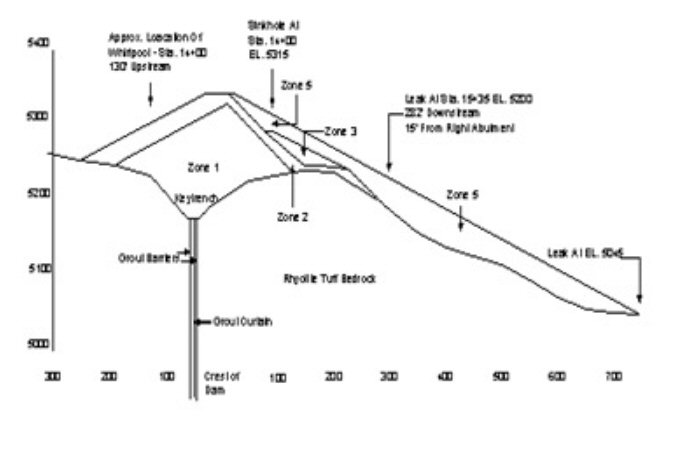
The Teton Dam, built on the Teton River in Idaho failed on 5 June 1976 as it was filling. 94m high, it cost $100 million to build; built by the US Bureau of Reclamation- to provide hydropower.

Ian Smalley 1992. The Teton Dam: rhyolite foundation + loess core = disaster. Geology Today 8, (no.1) 19-22.
Ian Smalley, Tom Dijkstra 1991. The Teton Dam (Idaho USA) failure problems with the use of loess material in earth dam structures. Engineering Geology 31, 197-203.

Geotechnical problems with loess usually involve hydroconsolidation and subsidence- the problems are caused by the presence of the open metastable structure of ground materials. What the Teton Dam failure demonstrates very clearly is that there are geotechnical problems associated with remoulded loess- it is not only the open structure that causes geotechnical problems- it is the nature of the ground itself. Problems arose within the field of soil mechanics because of an inclination to view ground materials as either cohesive (clayey) or cohesionless (sandy soils). Loess was a soil which was

NTU. In the late nineteen nineties Dr Mike Rosenbaum left Imperial College and moved to Nottingham Trent University as Professor of Geotechnical Engineering. His job was to develop research programmes in engineering geology and ground engineering. Ken had been working with Dr R at Imperial and eventually drifted over to NTU to continue the association; he joined the geotechnical team at NTU. On 29 September 2001 Ken gave a seminar in the Civil Engineering Department, very few records of this event remain but it was recorded that he mentioned loess and Greens functions (which relate to Fourier analysis and Fourier transformations - of which more later) Loess was mentioned, the fateful word was uttered.
Dr Raj Kumar. Raj came from India to work at NTU as a visiting research fellow. He arrived in September 2002 and he and Ken set about investigating the formation of quartz silt using a model glacier system which they developed. Actually the idea of using a Bromhead ring shear machine as a model glacier had originated with Janet Wright while she was doing her PhD at Queens Belfast. She was looking at ways of producing quartz silt for loess deposits and used a Bromhead ring shear machine to produce shear and crushing stresses to break sand grains. The Bromhead was a machine designed for use in soil mechanics laboratories which could produce a long time continuous shear stress. A circular sample could be deformed by circular platens and very long term tests were possible. Janet suffered from some problems with her Bromhead; it was not her machine (borrowed from another department) she was working within the close time constraints of a PhD project; she could not make significant modifications to the machine, and and she had to test other possible methods of producing silt- she could not concentrate solely on glacial grinding. Raj and K had more freedom of action. They designed and made rougher platens to more accurately represent the ground and glacier surfaces and they had their own dedicated Bromhead machines- new state of the art Bromheads in the NTU soil mechanics laboratory. Janet did not produce much silt from her machine but the K and Raj machines were very productive. Their best result (see illustration from a paper by Markovic & Smalley) was to show the stages in the deformation of sand grains by measuring the height of the sample vs. comminution time. [It has been suggested that this was the most significant research result produced by a Bromhead- but that would doubtless be disputed]. The sand sample is deformed; initially there is some slight dilatant expansion, then particle breakage begins; the Moss defects are activated and the conversion of sand to silt is achieved relatively quickly. Long term grinding takes the system close to the comminution limit. Enormous amounts of glacial grinding can produce ground systems containing large amounts of very small quartz particles (e.g. the Canadian quickclays) but a just-right amount of grinding (say to the end of stage 3)gives the quartz silt for loess deposits.

Golden Age. The proposed Golden Age of Loess Research in East & Central Europe is from 2006 to about 2020 (the onset of Covid which closed everything down). So K was there at the start of the golden age. The seeds were sown at the LoessFest in 1999 but the golden age bloomed in 2006 with the Marsigli loess meeting at the University of Novi Sad in Voyvodina in Serbia. The beginning of a large scale appreciation of the wonders of the loess in all parts of the Danube basin but particularly in parts where the river is augmented by flows from the Drava, Tisza and Sava and other large tributaries from the Alps and the Carpathians. The Marsigli loess meeting was in Novi Sad. Marsigli is credited with the first recognition and representation of loess in the Danube bank deposits [see blog for. K visited Stari Slankamen one of the classic loess exposures- one day maybe to be the site of the Loess Museum and participated in the celebrations at the great fortress of Petrovaradin -that great bastion of the Austro-Hungarian Empire. K lived in the Voyager Hotel on Strazilovska Street and ate in the Palermo cafe just around the corner.
Giotto Loess Research Group. The eccentrically named Giotto Loess Research Group came into existence at NTU. Giotto (as far as we know) had nothing to do with loess- the association is a purely NTU phenomenon. During K's time at NTU there were many reconfigurations and renamings of the civil engineering section and many moves of people and plant. NTU was building and rebuilding; the old Art School was built into a new construction in such a way that the external walls became internal divisions and this resulted in K's office being dominated by a large bas-relief of Giotto that great pioneer of Italian Art- so he gave his name to the Loess Group. He looked down on the production of Loess Letter. LL was produced at NTU from LL35 to LL65- thats fifteen years of continuous production.

The Second LoessFest. The first LoessFest was held in 1999 at Heidelberg and Bonn. This was to celebrate the naming and definition of Loess by Karl Caesar von Leonhard in 1824. It was a great success; a large international meeting to discuss all aspects of loess. The main driver of the event was Professor Edward Derbyshire and he worked hard to raise funding for as many people as possible to attend. Ten years later there was an echo- a second LoessFest held at the University of Novi Sad in Voyvodina. In 2009 travel to Novi Sad was awkward; bus to Heathrow, then flight to Zurich, flight to Belgrade, drive to Novi Sad. K was accommodated in NS at one of the residences of UNS. This was located beside the River Danube and a modest distance from UNS proper. The journey between residence and university was accomplished by a stroll along the path beside the Danube- a brilliant way to start a day of discussions. The LoessFest in 2009 was quickly followed by the GeoTrends meeting in 2010 and K had a particularly happy meeting. His best moments were spent in discussion with Biljana Basarin talking about Fourier series and Fourier transforms (the K idea of heaven). Biljana was interested in Milankovitch cycles to control climate change in the Quaternary period so she was keen to apply Fourier principles to the cyclic nature of events.
Birds in Loess. The 2011 Loess meeting was in Poland, at the University of Wroclaw. There was a field trip to the east, into Ukraine, in particular to a quarry at Korshiv (a place that used to be in Poland but is now in Ukraine- quite close to the border). Good exposures of loess in the quarry and a remarkable population of sand martins. The exposed loess banks made ideal nesting territory for the birds and it was noticeable that they chose the best parts of the loess profile to excavate and nest in. To build a nest you need excavateability and shear strength, a compromise is required- which was later named the Heneberg compromise after the pioneer investigator.. The sand martins provided a fine demonstration of the remarkable nature of loess ground, and this suggested the use of birds as a loess 'indicator' ;birds will find loess for exploring geoscientists. Actually it turned out that, as suggested by Zdzislaw Jary, the best bird as a loess indicator was the bee eater, for some time the national bird of Hungary- the great loess inhabitant. Merops apiaster- the European bee eater favours loess as nesting ground and is widespread in Europe. Four papers were produced on the bee-eater/loess interaction and these provided satisfactory indicators of loess-like ground in Africa and Australia. There appears to be no (very little) loess in Australia but the Australian bee eater- the Rainbow Bird- does indicate regions of ground which are very loess-like. The Australian interaction is of particular interest.


Windy Day meetings at Leicester(2012) & Southampton(2013). The'Windy Day' meetings were held every year; an informal discussion of aeolian geomorphology- a chance to talk about sand and loess (see blog for 6 August 2022). The 18th WD meeting was held at Leicester University and K participated. The 19th meeting was held at Southampton University and was a bit unusual in that it was a long way from the usual Midlands milieu. Ken went on the bus, and so did Arya Assadi Langroudi. Arya was going to make his first presentation at a scientific meeting and he was understandably a bit apprehensive. Ken reassured him and offered encouragement and the presentation went well. The K-AAL relationship developed and K was able to offer more support when the PhD was due to be submitted.
ED@80: at UNS in 2012. K back in the UNS residence; more walking along the Danube path, more conferences with Biljana, more exciting discussions of Fourier series and their consequences. Ed Derbyshire to UNS to celebrate his contribution to Loess world. An exciting excursion to the south-east towards Belgrade, to the Roman settlement of Viminacium and a Roman dinner complete with wine in amphorae. This was a very impressive celebration for Professor Derbyshire and led to the publication of two notable volumes of loess papers (in Catena and Quaternary International). Viminacium was largely exposed because of associated mining for near surface coal- which also exposed some remarkable mammoth remains- visited and admired. It was at this ED@80 meeting that Randall Schaetzl of Michigan St University proposed that Loess Letter be totally published online- he undertook to publish the entire LL oeuvre, which amounted to 70 issues from his base at East Lansing.
GeoTrends 2 at Wroclaw (2017). The last of the Central European adventures. K stayed at the Figa Hostel in Cybulskiego Street; Tom Hose was there and they had long conversations on most arcane topics but mostly on putting down plank floors in attic rooms. The meeting included a very impressive field trip to the south-western part of the country, into the Sudetic Geopark. Landscape models were admired.


Finale 2018. K drove down to Northampton for the 25th Windy Day meeting- his last scientific excursion. He took Ian Smalley and a Chinese visitor. They all admired the new Northampton campus and were very careful to return their identification devices. Ken was still writing occasional poetry and it seems fitting to end this appreciation with a few simple lines of K verse:
For the time I will reside/ In a universe in dimension five / In my immortal soul of light I am alive/ Awaiting in what new life I will survive/ So when I am gone be happy for me [KOHD]


